
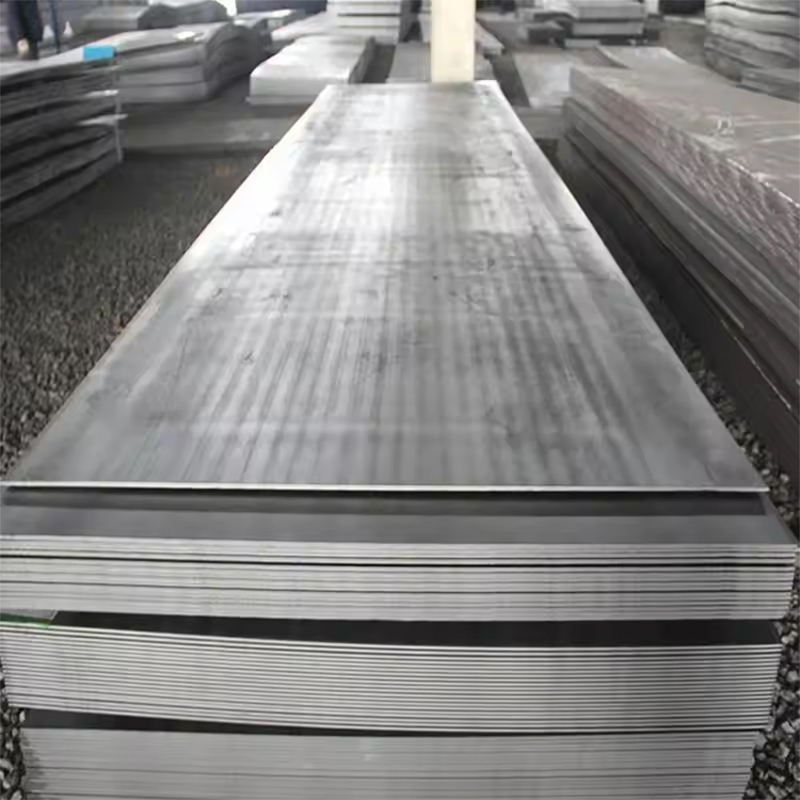
I. Process Essence: Temperature is Decisive
Hot Rolling Process: Rolling is performed above the steel's recrystallization temperature (typically over 1100°C). Similar to "striking while the iron is hot," the high temperature makes the steel slab soft and pliable, allowing for significant shape changes and thickness reduction.
Cold Rolling Process: Rolling is performed below the steel's recrystallization temperature (typically at room temperature). It is a subsequent precision processing step carried out on semi-finished products from hot rolling, such as hot-rolled coils.
II. Property and Appearance Comparison: Distinct Advantages
| Characteristic | Hot-Rolled Steel | Cold-Rolled Steel |
| Surface Quality | Surface has mill scale (bluish-gray), is slightly rough, and may have minor imperfections. | Surface is smooth, bright, free of scale, with a fine texture and superior appearance. |
| Dimensional Accuracy | Tolerances are larger; thickness and shape control are relatively lenient. | Tolerances are tightly controlled with high dimensional accuracy and uniform thickness. |
| Mechanical Properties | Relatively lower strength, with good toughness and ductility. Easy to weld and further process. | Strength and hardness are significantly increased through "work hardening," but toughness is reduced. |
| Internal Stress | Essentially no residual stress. | Contains significant internal stress, usually requiring annealing to restore some plasticity. |
| Production Cost | Shorter process, lower energy consumption, relatively low cost. | Multiple steps (pickling, rolling, annealing, etc.), higher energy consumption, higher cost. |
III. Typical Application Fields: Right Material for the Job
Based on these properties, each process has its clear "domain" in the market:
Applications of Hot-Rolled Steel:
Structure & Construction: Bridge frameworks, reinforcing bars, H-beams, tower structures – where surface finish is not critical, but good strength and weldability are required.
Heavy Equipment: Truck chassis, crane girders, ship structural components.
Pipelines & Pressure Vessels: Large-diameter welded pipes for oil/gas transmission, storage tank shells.
Raw Material for Further Processing: Serves as the base material for deep processing like cold rolling or galvanizing.
Applications of Cold-Rolled Steel:
Precision Manufacturing & Appliances: Automotive body panels, appliance casings (refrigerators, washing machines), computer cases – requiring excellent appearance and precise dimensions.
High-End Metal Products: Office furniture, filing cabinets, lighting fixtures, high-quality utensils.
Thin-Wall Components: Various sheets, strips, and tinplate for food cans with thicknesses under a few millimeters.
High-Strength Components: Utilizing its high hardness for certain structural parts, blades, etc.
IV. Selection Guide: How to Make the Right Choice?
When selecting steel for your project, follow this decision path:
Priority: Appearance & Precision: If the product is a final consumer good or a visible component requiring a smooth, attractive surface and precise dimensions, cold-rolled sheet should be prioritized.
Evaluate Strength & Forming Needs: If very high strength or complex intermediate stamping (e.g., automotive body panels) is required, cold-rolled sheet (especially after annealing) is the better choice. For heavy forging, bending, or welding, hot-rolled sheet offers better workability.
Consider Cost Budget: If basic performance requirements are met and the part is not visible or has lenient surface/dimensional needs, choosing hot-rolled steel can significantly reduce costs.
Define Final Finishing Process: If surface treatments like plating or painting are planned, the smooth surface of cold-rolled sheet provides a better base.
Conclusion
Hot rolling and cold rolling are not about which is superior, but rather two solutions for different needs. Hot rolling is the foundational process that shapes the skeleton of steel—economical and tough. Cold rolling is the enhancement process that achieves precision and aesthetics—refined and high-strength. As a comprehensive steel product supplier, we offer a full range of both hot-rolled and cold-rolled products along with professional material selection consultation. We help you find the optimal balance between performance, appearance, and cost, providing the strongest material core for your products.